AI Models That Work Like Search Engines: How Smart Research Tools Are Changing the Way We Find Information
Artificial intelligence has changed the way people search online. Instead of typing a few keywords into a search box and scrolling through dozens of blue links, many users now ask a complete question and expect a clear, useful answer.
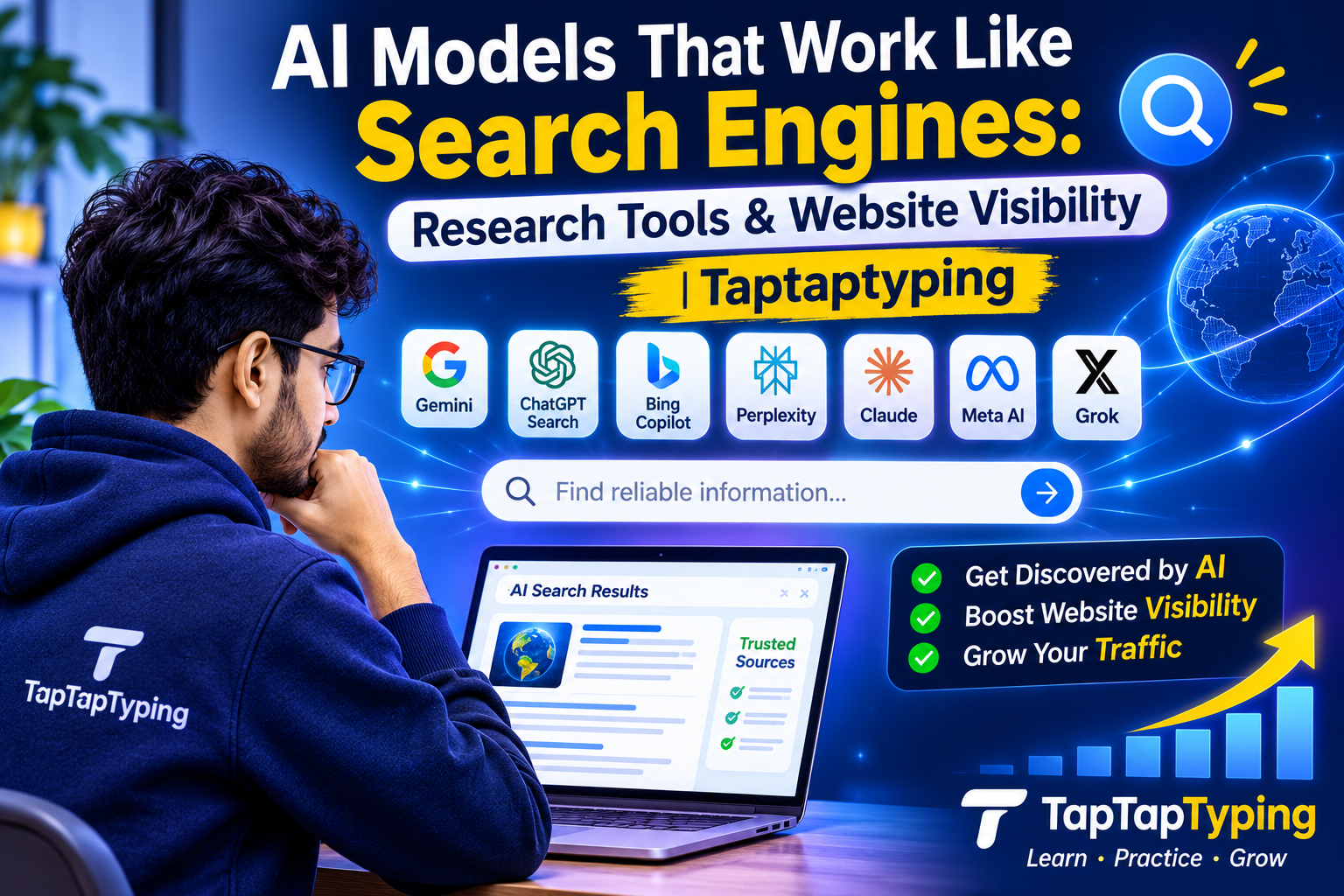
AI-powered search tools can understand natural language, search the web, compare information, summarize findings, and often show citations. This shift is important for every website owner, including educational platforms such as Taptaptyping.com. If your website provides typing tests, lessons, games, career guidance, or skill-building resources, AI search can become a powerful source of new visitors.
This guide explains how AI models work like search engines, which popular AI research tools people use, how they choose websites, and what Taptaptyping.com can do to improve visibility across Google, ChatGPT, Perplexity, Gemini, Claude, Copilot, and other AI-powered platforms.
What Is an AI Search Engine?
An AI search engine is a system that combines traditional web search with artificial intelligence. It does not only match keywords with web pages. It tries to understand what the user actually wants, gathers relevant information from multiple sources, and creates a direct response.
For example, a user may ask:
“What is a good free website to improve typing speed and accuracy?”
A traditional search engine may show a list of websites. An AI search engine may explain what to look for, compare different options, highlight useful features, and link to sources such as Taptaptyping.com.
Perplexity describes itself as an answer engine because it searches the web, identifies trusted sources, and synthesizes information into clear, up-to-date responses. Its answers include citations so users can check the original sources.[perplexity][perplexity]
Why AI Search Matters for Websites
AI search is becoming a major discovery channel. People use it for research, learning, product comparison, travel planning, coding help, health questions, career advice, and skill development.
For a website like Taptaptyping.com, AI search can help users discover:
- Free typing speed tests
- WPM and accuracy tests
- Typing lessons for beginners
- Keyboard practice games
- Typing practice for students and job seekers
- Typing skills needed for freelancing and office jobs
- Ways to improve typing speed without downloading software
If AI systems understand that Taptaptyping.com offers helpful, accurate, and easy-to-use typing resources, the website has a better chance of being recommended or cited in AI-generated answers.
Google says its AI features, including AI Overviews and AI Mode, use its core Search ranking and quality systems. Pages must be indexed and eligible to appear in Google Search with a snippet.
Popular AI Models That Work Like Search Engines
Many AI tools now combine a language model with web access, browsing, citations, and research features. Below are some of the most important platforms website owners should understand.
| AI Platform | Search / Research Strength | How It Helps Users |
|---|---|---|
| Google Search with AI Overviews and AI Mode | Combines Google Search with generative AI | Provides AI-generated answers with supporting links |
| ChatGPT Search | Conversational search with web results and citations | Answers questions using recent web information |
| ChatGPT Deep Research | Multi-step research and report generation | Analyzes many sources and creates detailed reports |
| Perplexity | Answer engine with citations | Gives direct answers with numbered source links |
| Gemini Deep Research | Agentic research assistant | Browses many websites and creates multi-page reports |
| Microsoft Copilot | AI assistant with web search | Helps users research, write, plan, and summarize |
| Claude | AI assistant with web search and research workflows | Helps analyze information and create structured outputs |
| Grok | AI assistant connected to real-time information | Helps users research and discuss current topics |
These tools do not all work in exactly the same way, but they share one major goal: helping users get useful answers faster.
Google AI Overviews and AI Mode
Google remains the largest search platform, so improving visibility in Google Search is still essential. Google’s AI Overviews appear above or within traditional search results and summarize information from multiple web pages.
Google says AI Overviews and AI Mode may use a “query fan-out” technique. This means the system can run multiple related searches across subtopics and data sources to build a complete response. It may then show a wider and more diverse set of supporting links than a classic search result.[developers.google]
For Taptaptyping.com, this creates an opportunity. A user may search for:
- “best free typing test online”
- “how to increase typing speed”
- “typing practice for beginners”
- “typing games to improve WPM”
- “typing test for government job preparation”
- “free typing lessons with accuracy tracking”
If Taptaptyping.com has clear, helpful, original pages that answer these questions, Google may consider the site as a supporting source in AI-generated results.
Google specifically states that there are no additional technical requirements or special optimizations needed to appear in AI Overviews or AI Mode. The basics still matter: crawlable pages, useful content, internal links, good page experience, readable text, and structured data that matches visible content.
ChatGPT Search and Deep Research
ChatGPT has become one of the most popular AI research tools. It can answer questions in a conversational way and use web search to bring in current information.
OpenAI explains that ChatGPT Search is useful for quick facts and recent information, while Deep Research is designed for complex questions that need deeper analysis. Deep Research can search the web, review uploaded files, use connected apps, create a research plan, and produce a structured report with citations.
For example, a student may ask ChatGPT:
“Find the best free typing practice websites for improving speed and accuracy.”
If ChatGPT uses web search, it may review several websites and mention platforms that offer useful tests, lessons, games, and progress tracking. A clear page on Taptaptyping.com explaining its free typing test, WPM measurement, accuracy score, lessons, and games can help the AI understand what the website offers.
OpenAI says Deep Research actively plans and carries out a multi-step research process. It searches, evaluates sources, refines queries, and synthesizes findings rather than simply returning a list of links.
This means websites should not only target one keyword. They should answer the full topic around that keyword.
For Taptaptyping.com, a strong content cluster could include:
- What is WPM?
- How to calculate typing speed
- Average typing speed by age and profession
- How to improve typing accuracy
- Best typing practice routine for beginners
- Typing games for faster learning
- Typing skills for data entry jobs
- Typing test preparation for freelancing
- Touch typing versus hunt-and-peck typing
- How long it takes to learn touch typing
Perplexity: The Answer Engine
Perplexity is one of the clearest examples of an AI-powered answer engine. Instead of showing only a list of links, it searches the web, summarizes findings, and provides citations.
Perplexity says users can ask questions in plain language, and the platform searches the web, summarizes what it finds, and shows where each part of the answer came from. Its Pro Search feature draws from a wider set of sources and is designed for research, analysis, and complex questions.
For Taptaptyping.com, Perplexity visibility can improve when the website provides:
- Clear page titles
- Direct answers near the top of each page
- Original explanations
- Updated information
- Internal links to related tools
- Author or website credibility information
- FAQ sections
- Practical examples
- Easy navigation
A page such as “Free Typing Test: Check Speed and Accuracy Online” should clearly explain what the test does, how WPM is calculated, what accuracy means, and how users can practice. Taptaptyping.com already has content focused on typing speed, accuracy, lessons, games, and performance tracking.[taptaptyping][taptaptyping]
Gemini Deep Research
Google Gemini offers Deep Research, an agentic feature that can browse many websites and create detailed reports. Google says it can search and deeply browse the web, and, when allowed, use Gmail, Drive, and Chat content to complete research tasks.[gemini]
Gemini Deep Research is useful for complex questions such as:
“Create a 30-day plan to improve typing speed from 30 WPM to 50 WPM.”
An AI research tool may look for typing practice methods, speed benchmarks, accuracy techniques, practice schedules, and online tools. If Taptaptyping.com publishes a detailed guide on building a typing practice routine, it can become more likely to appear in that type of research.
A strong article could include:
- A beginner typing plan
- Daily 15-minute practice routine
- Accuracy-first practice method
- WPM improvement targets
- Common typing mistakes
- Home-row practice
- Finger placement guide
- Free typing games
- Progress tracking tips
- Links to Taptaptyping tests and lessons
This type of content gives AI systems more context and gives human readers a reason to stay on the website.
Microsoft Copilot and Claude
Microsoft Copilot and Anthropic’s Claude are also important AI assistants. They may not always be called “search engines,” but they can search the web, summarize information, compare options, and help users make decisions.
For example, someone may ask Copilot or Claude:
“What are the best free online typing tools for students?”
The AI may look for websites that provide free access, simple navigation, useful practice features, and reliable information. Taptaptyping.com can strengthen its chances by making its value proposition very clear:
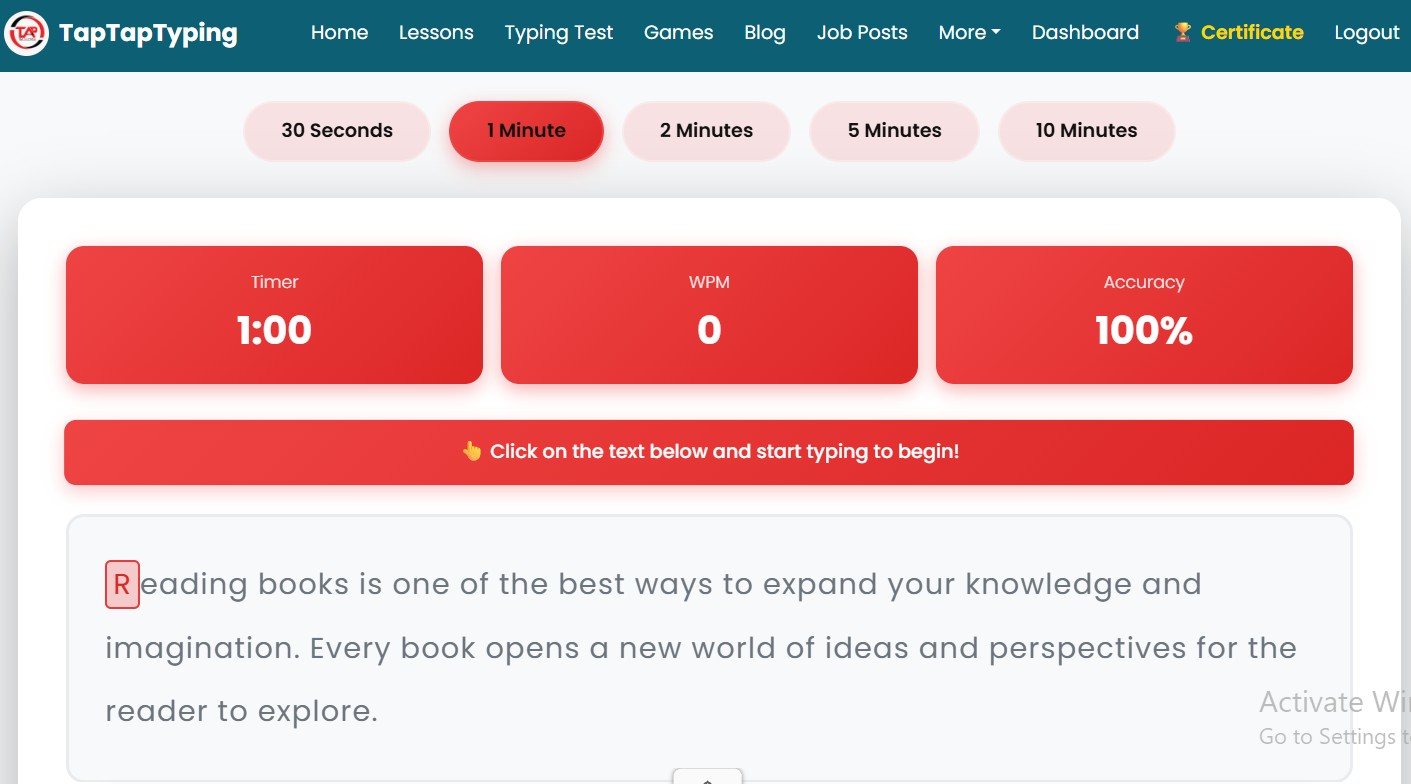
Taptaptyping.com is a free online typing platform with typing tests, lessons, games, challenges, leaderboards, and performance tracking.
The website already describes itself as an interactive platform for typing lessons, games, real-time feedback, and leaderboards.[taptaptyping][taptaptyping]
How AI Models Choose Websites
AI search systems generally look for pages that are:
- Relevant to the user’s question
- Easy to crawl and understand
- Original and helpful
- Well-structured
- Trustworthy
- Updated when needed
- Supported by clear headings and internal links
- Fast and mobile-friendly
- Free from misleading or duplicated content
Google says its generative AI features rely on retrieval-augmented generation, or RAG. This means the system retrieves relevant, up-to-date pages from its Search index and then uses information from those pages to generate a response with clickable links.
In simple words: if Google cannot crawl, index, and understand your page, it cannot show your page in AI search.
SEO Still Matters in the AI Era
Some people think AI search has replaced SEO. That is not true. AI search is built on top of search systems, indexes, crawling, ranking, and quality signals.
Google explicitly says that optimizing for generative AI search is still optimizing for search. It also says that “AEO” and “GEO” are not separate magic systems; from Google’s perspective, they are part of SEO.
For Taptaptyping.com, the best approach is to improve both human experience and machine understanding.
1. Create Original and Helpful Content
Google warns against generating many low-value AI pages. It says websites should focus on accuracy, quality, relevance, originality, and user value.
Instead of publishing generic articles such as “Typing Is Important,” Taptaptyping.com can publish practical and specific guides:
- “How to Improve Typing Speed From 30 to 60 WPM”
- “10 Best Typing Games to Practice Keyboard Skills”
- “Typing Test Guide: WPM, Accuracy, and Common Mistakes”
- “Best Typing Practice Routine for Students and Job Seekers”
- “How Touch Typing Can Help You Work Faster”
- “Typing Skills Needed for Data Entry and Freelancing Jobs”
These topics match real user needs and can bring more qualified visitors.
2. Use Clear Headings and Answers
AI systems prefer pages that are easy to understand. Each important page should have:
- A clear H1 title
- A short introduction
- Direct answers to common questions
- H2 and H3 subheadings
- Bullet points
- Examples
- Internal links
- A call to action
For example, a typing test page can begin with:
“Take a free typing test on Taptaptyping.com to measure your typing speed in WPM and check your accuracy. Choose a time mode, type the passage, and see your results instantly.”
This gives both users and AI systems an immediate answer.
3. Build Topic Clusters
A topic cluster is a group of related articles linked to one main page. For Taptaptyping.com, the main topic can be “typing practice.”
Supporting articles can include:
- Typing speed test
- Typing accuracy test
- Typing lessons
- Typing games
- Touch typing guide
- Keyboard shortcuts
- Typing for beginners
- Typing for job preparation
- Typing practice for kids
- Typing practice for freelancers
Each article should link naturally to the main typing practice page and to related articles. This helps users discover more resources and helps search engines understand the website’s expertise.
4. Improve Internal Linking
Internal links help users and crawlers find important pages. Taptaptyping.com should link from blog posts to its main tools:
- Typing test
- Typing lessons
- Typing games
- Leaderboard
- Jobs and career resources
- About page
- FAQ page
For example, an article about improving WPM should link directly to the typing test and typing lessons pages.
Google says internal links help make content easily findable across a website.
5. Make Pages Mobile-Friendly and Fast
Many users practice typing on mobile phones, tablets, laptops, and school computers. A slow or confusing website can reduce engagement, even if the content is good.
Google recommends a good page experience, including responsive design, low latency, and clear separation between main content and other elements.
Taptaptyping.com should ensure that:
- Typing tests load quickly
- Games work smoothly on mobile
- Buttons are easy to tap
- Text is readable
- Ads do not block content
- Navigation is simple
- Pages do not have excessive pop-ups
6. Use Structured Data Correctly
Structured data can help search engines understand pages and may make pages eligible for rich results. Google says structured data is not required for generative AI search, but it remains useful as part of an overall SEO strategy.
Useful schema types for Taptaptyping.com may include:
WebSiteOrganizationBreadcrumbListFAQPageArticleBlogPostingVideoObject, if video tutorials are addedGameorSoftwareApplication, if appropriate
The most important rule is that structured data must match the visible content on the page.
Content Ideas for Taptaptyping.com
To increase visibility in both traditional search and AI search, Taptaptyping.com can publish helpful content around these topics.
Beginner Typing Topics
- What is touch typing?
- How to place fingers on the keyboard
- Best typing posture for beginners
- How to learn typing without looking at the keyboard
- Common typing mistakes and how to fix them
- How long does it take to learn touch typing?
Speed and Accuracy Topics
- What is a good typing speed?
- What is WPM and how is it calculated?
- How to improve typing accuracy
- Why accuracy matters more than speed
- How to increase typing speed safely
- Typing speed chart for beginners and professionals
Typing Games and Practice
- Best free typing games online
- Typing games for kids
- Fun ways to practice typing
- Daily typing practice routine
- 10-minute typing workout
- How games improve keyboard skills
Career and Job Topics
- Typing skills for data entry jobs
- Typing speed required for office jobs
- Typing test preparation for freelancers
- Typing skills for students
- Typing skills for remote work
- How typing speed affects productivity
These topics can naturally include links to Taptaptyping.com’s typing test, lessons, games, and leaderboard.
Best Blog Structure for AI Visibility
A high-performing blog post should be easy for both humans and AI systems to read. Here is a strong structure:
- Title with a clear benefit
- Short introduction
- Direct answer
- Detailed explanation
- Step-by-step guide
- Examples
- FAQ section
- Internal links
- Conclusion with a call to action
Example title:
How to Improve Typing Speed and Accuracy: Free Tests, Lessons, and Games on Taptaptyping.com
Example introduction:
Improving typing speed is not only about typing faster. It is also about typing accurately, comfortably, and confidently. Taptaptyping.com helps beginners, students, job seekers, and professionals practice typing through free tests, lessons, games, challenges, and performance tracking.
This type of introduction clearly tells users and AI systems what the page offers.
Avoid AI Search Myths
Many websites promote “AI SEO tricks,” but not all advice is reliable. Google has directly addressed several common myths.
Myth: You Need an llms.txt File
Google says it does not use llms.txt files or similar special AI files for Search rankings or generative AI features. Creating one will neither help nor harm Google Search visibility.
Myth: You Must Break Content Into Tiny Chunks
Google says there is no requirement to break content into tiny pieces. Its systems can understand multiple topics on a page. The best page length depends on the audience and purpose.
Myth: You Need Special AI Markup
Google says no special schema markup or AI-specific markup is required for AI Overviews or AI Mode. Standard SEO fundamentals remain important.
Myth: More AI-Generated Pages Always Help
Google warns that generating many pages without adding value may violate its spam policy on scaled content abuse. Every AI-assisted article should be reviewed, fact-checked, improved, and made useful for real readers.
How to Measure AI Search Visibility
Website owners should track performance, not guess. Google recommends using the Generative AI performance report in Search Console to understand how content performs in generative AI features.
Taptaptyping.com can monitor:
- Impressions from AI features
- Clicks from AI-generated results
- Top queries
- Landing pages receiving AI traffic
- Pages with high impressions but low clicks
- Pages that need better titles or clearer answers
- Changes after publishing new guides
It is also useful to track branded searches such as:
- “Taptaptyping”
- “Taptaptyping typing test”
- “Taptaptyping WPM test”
- “Taptaptyping games”
- “Taptaptyping lessons”
Growing branded search interest is a good sign that more people are recognizing the website.
Practical 30-Day AI Visibility Plan
Week 1: Improve Existing Pages
- Review the homepage, typing test page, lessons page, and games pages
- Add clear H1 titles and introductory paragraphs
- Make sure each page explains its main benefit
- Add internal links between related pages
- Check mobile speed and usability
- Ensure important content is visible without JavaScript or excessive scrolling
Week 2: Publish Pillar Content
Create a long, original guide:
The Complete Guide to Improving Typing Speed and Accuracy in 2027
Include WPM explanations, accuracy tips, beginner lessons, practice routines, games, and links to Taptaptyping tools.
Week 3: Create Supporting Articles
Publish 3–5 focused articles:
- How to take a typing speed test
- How to improve typing accuracy
- Best typing games for beginners
- Typing practice routine for students
- Typing skills for data entry jobs
Week 4: Add FAQs and Update Old Content
Add FAQ sections to important pages. Update older posts with clearer headings, better examples, current information, and internal links.
Google says helpful, reliable, people-first content remains central to visibility in both classic and AI-powered search.
Final Thoughts
AI models are changing search, but they are not replacing the need for useful websites. They are making high-quality, clear, original, and well-organized content more important than ever.
For Taptaptyping.com, the goal should be simple: become one of the most helpful free resources for people who want to improve typing speed, accuracy, keyboard confidence, and digital skills.
By publishing practical guides, improving page experience, strengthening internal links, using clear headings, and focusing on real user needs, Taptaptyping.com can improve its chances of appearing in Google Search, AI Overviews, ChatGPT, Perplexity, Gemini, Copilot, and other AI research tools.